
Prefab, modular, panelized, manufactured, and site-built homes compared: the codes, the honest pros and cons, and who each option fits.
The short answer
Prefab construction means building a home, or big pieces of it, in a factory and assembling it on your lot. "Prefab" is an umbrella: modular homes, wall panels, precut kits, and HUD-code manufactured homes all qualify. What matters in California is the building code it follows and who inspects it.
of new U.S. single-family homes completed in 2025 were site-built (U.S. Census Bureau)
modular single-family homes completed in the U.S. in 2025, about 1% of the total
average price of a new manufactured home in California in 2025, home only (Census)
Modular homes follow California's building code; manufactured homes follow a federal HUD code
"Prefab" gets stuck on everything from a backyard shed kit to an apartment building craned in box by box. No wonder people are confused. Two homes can both be called prefab and follow different building codes, use different loans, and get inspected by different people.
This guide sorts out the terms — prefab, modular, panelized, manufactured, and site-built — with the rules California and federal agencies actually use. Then it gives you an honest list of pros, cons, and who each option fits.
What is prefab construction?
Prefab (short for prefabricated) construction is any building method where major parts of a home are made off-site, in a factory, and then shipped to the lot for assembly. It describes a process, not a single product or building code.
Prefab homes still need a lot of work on site. Someone has to pull permits, grade the ground, pour a foundation, run water, sewer, and power to the house, and set the pieces. The difference is where the walls, floors, wiring, and plumbing get built: under a roof instead of in your yard.
Prefab vs. modular vs. manufactured vs. panelized: what's the difference?
The difference is how finished the pieces are when they arrive and which code they're built to. In California, modular homes and closed wall panels are "factory-built housing" under state law; manufactured homes follow a federal code; open-frame panels and kits are inspected like a site-built house.
| Type | What arrives on your lot | Building code in California | Who checks the factory work |
|---|---|---|---|
| Modular | Finished, box-shaped modules with walls, wiring, and plumbing already closed up | California Building Standards Code (Title 24) | HCD-certified agencies; each unit gets an HCD insignia |
| Closed panelized | Wall, floor, or roof panels with wiring or plumbing sealed inside | California Building Standards Code (Title 24) | HCD-certified agencies; components get a red HCD insignia |
| Open panelized or precut kit | Framed panels or cut lumber with walls left open | California Building Standards Code (Title 24) | Your city's inspectors, on site, like a site-built home |
| Manufactured (HUD code) | One or more sections built on a permanent chassis | Federal standards, 24 CFR Part 3280 | The federal HUD program |
| Site-built | Lumber and materials, built piece by piece in your yard | California Building Standards Code (Title 24) | Your city's inspectors, on site |
Sources: Health and Safety Code § 19971; HCD Factory-Built Housing Handbook (FBH 314, rev. 11/20); 24 CFR § 3280.2.
The dividing line in California law is simple: can an inspector see inside the walls on your lot? If not, the state's Factory-Built Housing program takes over and the inspection happens in the factory. Our guide to factory-built housing in California walks through that program step by step.
Watch out
"Modular" and "manufactured" are not interchangeable. Fannie Mae, for example, says modular, prefabricated, panelized, or sectional housing "is not considered manufactured housing" and treats it like a site-built home, while manufactured homes have their own separate rules. Use the right word with your lender.
How common is prefab construction in the U.S.?
Less common than the headlines suggest. In 2025, about 97% of new single-family homes completed in the U.S. were site-built, roughly 1% were modular, and 2% were panelized or precut, according to the Census Bureau.
| New single-family homes completed, 2025 | United States | West |
|---|---|---|
| Site-built | 975,000 | 221,000 |
| Modular | 14,000 | 2,000 |
| Panelized and precut | 16,000 | 1,000 |
| Total | 1,005,000 | 224,000 |
U.S. Census Bureau, Characteristics of New Housing, "Type of Construction Method of New Single-Family Houses Completed." Manufactured homes are counted separately.
Manufactured homes are a bigger slice. Factories shipped 103,314 new manufactured homes in 2024, compared with about 1,013,000 single-family housing starts that year, according to the Census Bureau's survey for HUD.
What are the pros of prefab construction?
The main advantages come from building indoors: less weather delay, a controlled work environment, and less time with a construction crew in your yard. California's housing department lists time and cost savings too, with a caveat that benefits vary by project.
- Weather doesn't stop the work. HCD lists "built year-round without typical weather constraints" among the program's benefits.
- A controlled environment. HCD lists "manufactured in a controlled environment" as a benefit: materials stay dry, and tools and crews work in one place.
- Less waste. HCD lists "less material waste" as a benefit of factory production.
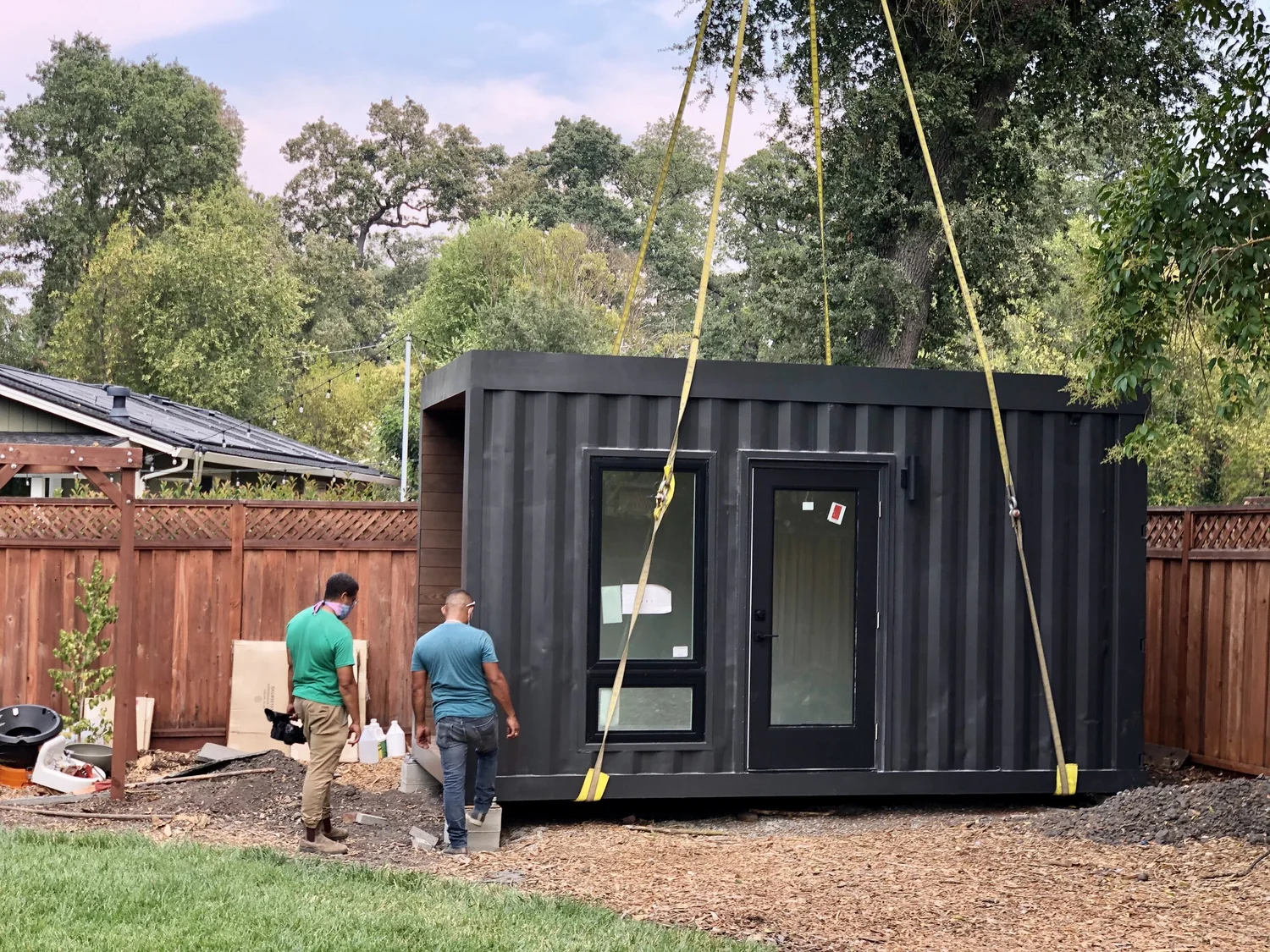
- Less disruption at home. A Bay Modular ADU is delivered in a day and installed in about a week; the rest of the building happens in our factory, not your yard.
- Inspection in the factory. For California factory-built housing, an HCD-certified agency inspects the work while the walls are still open.
HCD's pamphlet lists its benefits with a fair warning attached: "Benefits vary with each FBH project." We agree. A good prefab project still depends on the lot, the permits, and the team.
What are the cons of prefab construction?
Prefab doesn't skip the site work, it needs a clear path for a truck and crane, and you have to make decisions early. And not every lot or design is a good fit.
- The site still costs real money. On our 1 Bedroom ADU, permits, site prep, foundation, delivery, crane, and utility connections are all part of our all-in price — many other quotes leave them out.
- Access matters. The finished unit has to reach your yard. Power lines, big trees, steep slopes, or a narrow side yard can complicate delivery.
- Changes get harder later. Once a factory-built unit has its state insignia, it can't be modified before installation without HCD approval (Health and Safety Code § 19981).
- Fewer builders to compare. With modular at about 1% of new homes, you may find only a few companies to compare in your area.
- Manufactured homes play by different rules. Loans, appraisals, and ownership records for HUD-code homes differ from those for site-built and modular homes.
Is prefab cheaper than site-built?
Sometimes, but not automatically. Manufactured homes cost far less per square foot than site-built homes; for modular homes, we couldn't find a reliable recent study comparing them with site-built.
In 2024, a new manufactured home averaged $84.45 per square foot, while the structure of a new site-built home sold with its land averaged $168.86 per square foot excluding the land, according to the Census Bureau's cost comparison. Those are different products built to different codes, so it's not an apples-to-apples comparison.
For a modular ADU, the clearest way to judge cost is a complete quote. Bay Modular's all-in prices run from $124,900 for a 256 sq ft studio to $271,900 for a 640 sq ft two-bedroom, with permits, foundation, delivery, crane, and hookups included. Our 2026 ADU cost guide breaks down every line.
Who is prefab construction right for?
Prefab tends to suit homeowners who want a known design and price for the home itself and less time with construction in the yard. It suits less well when a design is one of a kind or the lot is hard to reach.
You want a backyard ADU from a proven floor plan, a fixed price for the house, and a short on-site timeline.
Factory-built (modular)You want the lowest price per square foot and are comfortable with HUD-code rules and financing.
Manufactured home (can be an ADU under Gov. Code § 66313)You want a one-of-a-kind design with lots of changes during construction.
Site-built or panelized may fit betterYour backyard has no path for a truck or crane.
Ask for a site check before you choose a methodNot sure your lot works for prefab?
We review satellite imagery, mark the buildable area and delivery access, and check your city's ADU rules. Free, with no obligation.
Frequently asked questions
Is prefab the same as modular?
Not exactly. Modular is one type of prefab: the home arrives in finished, box-shaped modules. Prefab also covers panelized homes, precut kits, and HUD-code manufactured homes.
What's the difference between modular and manufactured homes?
In California, modular homes are built to the state building code and installed on a permanent foundation. Manufactured homes are built to a federal HUD code on a permanent chassis. Lenders such as Fannie Mae treat them differently.
Can a prefab home be an ADU in California?
Yes. California's ADU law includes manufactured homes in the definition of an ADU (Gov. Code § 66313), and factory-built modular units are also used as ADUs. Your city reviews it under the same state ADU rules.
Are prefab homes good quality?
In California, modular homes are built to the same building code as site-built homes and inspected in the factory by HCD-certified agencies. Quality still depends on the builder, so ask to see units in progress. We cover this and other worries in common prefab myths.
How long does a prefab ADU take?
It depends mostly on permits. Your city has 60 days to approve or deny a complete ADU application (Gov. Code § 66317). After that, a Bay Modular unit is delivered in a day and installed in about a week.
See prefab up close
Tour our factory in Lathrop or send your address for a free lot assessment. No obligation.
About Bay Modular Team
Bay Modular is a California factory-built housing manufacturer (HCD #1585366). We design and build backyard ADUs in our factory in Lathrop, CA, and install them across California. More about us
Sources
- U.S. Census Bureau, Characteristics of New Housing, "Type of Construction Method of New Single-Family Houses Completed," 2025 data. Accessed October 8, 2026.
- U.S. Census Bureau, Manufactured Housing Survey (sponsored by HUD): average sales price by state, 2025; "Cost & Size Comparisons: New Manufactured Homes and New Single-Family Site-Built Homes, 2014–2024."
- California Health and Safety Code § 19971 and § 19981. Accessed October 8, 2026.
- HCD, Factory-Built Housing Handbook (FBH 314) and Factory-Built Housing FAQ (FBH 315), rev. 11/20, linked from HCD's FBH program page.
- Electronic Code of Federal Regulations, 24 CFR § 3280.2 (manufactured home definition).
- Fannie Mae Selling Guide, B2-3-02, Factory-Built Housing, February 4, 2026.
- HCD, Accessory Dwelling Unit Handbook, March 2026 (Gov. Code §§ 66313, 66317).
- Bay Modular Pricing & Financing, October 2026 (prices and cost breakdown).
This guide is general information, not legal, tax, or financial advice. Confirm details with your city's planning and building departments and a lender.
